things of water (slowly solidifying)

the women wet
the waterfront
with womb water
delivering twin coral children
whose ceilings
are fluid
and permutable.

he is one. i am the other.
brother and sister
who knew our selves
before brackishness
and the rift
caused by the damming
of the river.

she and i, twin occupiers
of our mother’s womb.
the hierarchy of birth order
mercurial
like gemini genes.

one stayed. the other went
-an absence that split the family
like a headache.

like choppy water
frothy and forthright
she spouts

destroying
the placidity of man
made emotion.

structurally unsound
deficient of reason
wet like a woman
she is fit
only for swallowing.

having grown to the depth
of a well
i could contain her
but don’t

having imbibed
and libated enough
to be at peace
i watch

she, whirling watery dervish
leaving in her wake
smashed houses
cars and broken glass
planes of an existence
thought permanent.

Blog Village Quotes and Links

It is undoubtedly a struggle for me to post consistently (read weekly or even bi-weekly). I get my head stuck in the latest book I’m reading or the process of writing my fourth book or motherhood or just play internet-tiredness. I know it. I also know it competes with my growing desire to build what I am now at peace with referring to as “my brand”. Therefore, instead of castigating myself I have decided to launch a new component to the Diary of a Mad Reader. Namely, instead of simply posting quotes from books that resonate with me, I will be incorporating links to interesting blogs I come across. This is the first “issue” of that component.

Today’s theme: Enter the Hood – Parent and Mother

http://anjuellefloyd.com/2012/of-vipassana-abandoned-dreams-and-the-map-of-true-places/

I am dedicated to taking care of our daughters first such that when all three reach adulthood I can focus the majority of my attention on writing, and without regret of what I did not provide our children.

http://focsimama.wordpress.com/2012/03/27/the-terrific-twos/

We have decided instead of saying, “Terrible Two’s” they are now to be called “Terrific Two’s”!

http://radiantramblings.wordpress.com/2012/07/19/what-the-heck/

Can you identify THIS:


www.ashafullife.blogspot.com/2011/06/i-aint-skeered.html

This agnostic mom goes on a lot of adventures and I manage to get myself into some awkward spots.  The latest adventure involves me agreeing to be a co-leader to my daughter’s Brownie Girl Scout troop.
Yeah, I’ll pause so you can soak that in and say a prayer, light a candle or do whatever it is that you people do when you want to save a child’s soul.
Over the weekend, I was able to go on an excursion to Oklahoma City for an overnight training session.  I knew ahead of time I would be staying at the Catholic Pastoral Center.  I joked with my friend, Julia that I’d probably be struck by lightning or something.

Review: The Last Days of Ptolemy Grey


The Last Days of Ptolemy Grey
The Last Days of Ptolemy Grey by Walter Mosley
My rating: 5 of 5 stars

I thought about writing a review of this book but when I finished it, I read the back cover text and saw this quote by Edwidge Danticat. It says what I feel about it so aptly, there is no need for me to reinvent the wheel.

“A beautiful meditation on love, fraility, and old age…as much a page-turner as it is a heart tugger. It is a novel that stays with you.” Edwidge Danticat

View all my reviews


Parsley ~ Rita Dove

1. The Cane Fields
There is a parrot imitating spring
in the palace, its feathers parsley green.
Out of the swamp, the cane appears

to haunt us, and we cut it down. El General
searches for a word; he is all the world
there is. Like a parrot imitating spring,

we lie down screaming as rain punches through
and we come up green. We cannot speak an R-
out of the swamp, the cane appears

and then the mountains we call in whispers Katalina.
The children gnaw their teeth to arrowheads.
There is a parrot imitating spring.

El General has found his word: perejil.
Who says it, lives. He laughs, teeth shining
out of the swamp. The cane appears

in our dreams, lashed by wind and streaming.
And we lie down. For every drop of blood
there is a parrot imitating spring.
Out of the swamp the cane appears.

2. The Palace
The word the general’s chosen is parsley.
It is fall, when thoughts turn
to love and death: the general thinks
of his mother, how she died in the fall
and he planted her walking cane at the grave
and it flowered, each spring stolidly forming
four-star blossoms. The general

pulls on his boots, he stomps to
her room in the palace, the one without
curtains, the one with a parrot
in a brass ring. As he paces, he wonders
who can I kill today. And for a moment
the little knots of screams
is still. The parrot, who has traveled

all the way from Australia in an ivory
cage, is, coy as a widow, practicing
spring. Ever since the morning
his mother collapsed in the kitchen
while baking skull-shaped candies
for the Day of the Dead, the general
has hated sweets, He orders pastries
brought up for the bird; they arrive

dusted with sugar on a bed of lace.
The knot in his throat starts to twitch;
he sees his boots the first day in battle
splashed with mud and urine
as a solder falls at his feet amazed-
how stupid he looked!-at the sound
of artillery. I never thought it would sing
the soldier said, and died. Now

the general sees the fields of sugar
cane, lashed by rain and steaming.
He sees his mother’s smile, the teeth
gnawed to arrowheads. He hears
the Haitians sing without R’s
as they swing the great machetes:
Katalina, they sing, Katalina,

mi madle, mi amol en muelte God knows
his mother was no stupid woman; she
could roll an R like a queen. Even
a parrot can roll an R! In the bare room
the bright feathers arch in a parody
of greenery, as the last pale crumbs
disappear under the blackened tongue. Someone

calls out his name in a voice
so like his mother’s, a startled tear
splashes the tip of his right boot.
My mother, my love in death.
The general remembers the tiny green springs
men of his village wore in their capes
to honor the birth of a son. He will
order many, this time, to be killed

for a single, beautiful word.

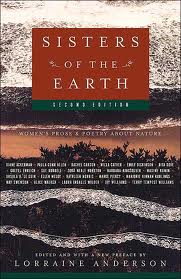
Mind in the Waters by Joan McIntyre (excerpt)

There was a time in our culture, not long ago, when the essential role of men and women was to nurture and protect each other, to be the caretakers of life and earth. At that time, when the sun sparkled on the sea of our imagination as freshly as it sparkled on the sea herself, we thought of our world and each other in ways which were life-venerating and death-respecting. The porpoise school that weaves its history protectively around its common existence, the whales that tune body and mind in a continuous awareness of life, are not symbols of an alien mythology-they are evocative of what was once the core of human relationships.

Animals were once, for all of us, teachers. They instructed us in ways of being and perceiving that extended our imaginations, that were models for additional possibilities. We watched them make their way through the intricacies of their lives with wonder and with awe. Seeing the wolf pick his delicate way across the snowy forest floor, the eyes of the owl hold the image of the mouse, the dark shape of the whale break the surface of the sea-reminded us of the grand sweep and diversity of life, of its infinite possibilities. The connection of humans with totemic animals was an essential need to ally ourselves with the power and intelligence of hon-human life, to absorb some of the qualities bestowed by the evolutionary process on other creatures.

Whales and dolphins-all Cetaceans-are intensely interesting to us now. They seem to speak for a form of consciousness we are beginning to re-explore in our own inner natures. They help us chart our interior wilderness. We can hear whales singing. If we pay attention and let them live, perhaps we will hear them speak, in their own accents, their own language. It would be an extravagant reward to experience, by empathy, a different band of reality.

We are animals of the land. They are animals of the oceans. We have hands to move and mold the things of the earth. They do not. But with an intelligence imagined as grand as ours – what do they do? What can they do, with mind imprisoned in all that flesh and no fingers for releasing it?

I have stroked, and swum with, and looked at these creatures, and felt their essence rise to meet me like perfume on a spring day. Touched by it, I felt gentler myself, more open to the possibilities that existed around me. There may be only one way to begin to learn from them-and that is to begin. We would not be harmed by returning to the roots which once nourished us, which still, unseen, link together all life that lives, and feels, and things and dies, on this, our common planet.

Excerpted from Sisters of the Earth: Women’s Prose & Poetry about Nature

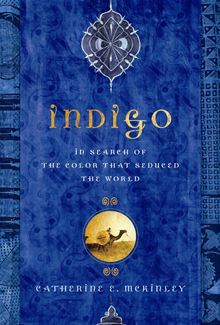
Indigo: In Search of the Color that Seduced the World (excerpt)

Living in the shadow of Elmina Castle, the first European building south of the Sahara, built in 1482 by the Portuguese and then occupied by the Dutch (and now a UNESCO World Heritage site for its importance in the transatlantic slave trade) was a small community of former Dutch army conscripts who had served in Indonesia. These men, part of three thousand ‘Donko’ slaves-the lowest caste of captives of the Ashanti empire-were sent to Indonesia from 1810 to 1840 under a system of de facto slavery. These men eventually bought their freedom with army service and resettled in Elmina beginning in the 1820s in a close-knit community of relatively elite ‘Old Javanese’ pensioners. They flew the Dutch flag, spoke Malay as a  common language, and put themselves at the disposal of the government, making expeditions into the interior. They dressed in Javanese cloth; the wrapped and togalike draped clothing of Akan men of the Gold Coast was not too dissimilar from Indonesian dress styles. These men’s lives have been little documented, but they are also partly responsible for Vlisco’s influence in West Africa.

The slave trade effectively ended in 1841, persisting for thirty years after its abolition under the 1814-1815 Vienna Congress. Profits from the colonial cloth trade had nonetheless grown so significant that the marker persisted long after the abolition of slavery. By 1876, when Vlisco began formally shipping cloth to the Gold Coast and concertedly pursuing and African market, they were extending the profits from goods that had long been exchanged and stored alongside captives in the holds of the coastal forts. Inside of Elmina Castle, the wrought iron railing to the main building bears a W, presumably for King William I, the Dutch king who sponsored the three factories that were the backbone of the Indonesian cloth trade, eventually inherited by Vlisco. Knowing this history put a new order to my thinking.

In the 1920s and 1930s Vlisco began a process similar to the Indonesian one with West African cloth designs. These cloths often incorporated traces of Indonesian designs, and ‘Java’ designs themselves became an expensive category of cloths sold in Africa.

In the Woodin window there was also a display of neon pink and blue and red ‘Angelina’, the iconic , usually dark green dashiki cloth emblematic of 1960s and 1970s Black and African identities and Black liberation struggles throughout the globe. It long predated the dashiki era and was one of the earliest ‘Java’ prints to be traded; ironically, the design had been inspired by Coptic patterning.

I kept thinking about Ghanaian women’s dressed and the ‘100% Guaranteed Real Dutch Wax’ stamp on the selvage, always-until the late 1960s, when the sepias and other colors were introduced-a crackling line of beautiful blue. Most women choose to display this selvage rather than fold it into their hemlines. Some of the most expensive ‘Super Wax’ cloths even feature the Vlisco logo as centerpieces to their designs. I had once read about an Alabama slave owner, a man named T. H. Porter, who made his chattel wear buttons with his name stamped into them. Buttons-much less custom designs-were such a relative luxury in Porter’s era, and slaves were afforded few or none. The arrogance of this requirement, the sick vanity, always stayed with me.

Ghanaian and other West Africans wear colonial and slave history in bright, intoxicating displays every day. In fact, the very measure of the cloth evokes the measure of a captive person’s life.