I. If you see me praying in the living room, never sit in front of me. You are not God.
Source: Yalie Kamara |

I. If you see me praying in the living room, never sit in front of me. You are not God.
Source: Yalie Kamara |
“Those familiar with my work already know that I champion Historical Poetry. They also likely know that no other group of poets has done more to define, establish, and make an argument for what clearly is a new genre than contemporary African American poets. No other cohort seems as committed to historical truth, arts activism, and paying tribute to our ancestors. Marilyn Nelson, Tyehimba Jess, Natasha Trethewey, and Adrian Matejka, are just a few who continue to pave the way and establish a standard of excellence in this area.”
Source: Harmonizing Black Voices through Historical Poetry-Frank X Walker | Free Black Space
A few year ago, lamenting the challenges of this juggling act, senior scholars in my department advised me to start thinking about my manuscripts as occupying different places in a pipeline, with proposals on one end and published articles at the other. The goal: Keep your papers distributed along that pipeline, and flowing through.
Source: My Writing Productivity Pipeline – The Chronicle of Higher Education
I often think my taste in music is schizophrenic. It encapsulates everything from Americana (aka American roots music) to the Roots, Rock, Reggae of Jamaica; the punk of Patti Smith to the grunge of Nirvana; from the punk of Bad Brains to the virtuoso of Nina Simone; musical storytellers from Bob Dylan to Wu-Tang Clan. Therefore, I decided a weekly post where I highlight the connections musicians themselves have made between their disparate musical forms.
First up: Ring of Fire
June Carter Cash’s Ring of Fire
Ray Charles’ Ring of Fire
Early spring, I went to a local (aka non-big box) gardening store. The experience wasn’t pleasant at all but I came away from the encounter with this growing bag in which I am growing sunflowers and amaranth (loves lies bleeding). The smallest sunflower is a variety I haven’t grown before (Endurance) and I don’t think I’ll grow them again next year. They freak me out a little because they don’t seem to follow the sun like the other two (Russian Mammoths).

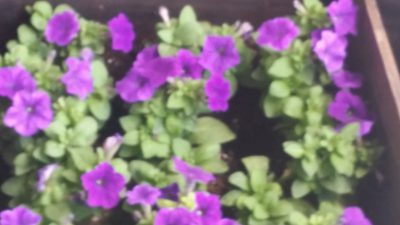
These are my petunias. I didn’t grow them from seed but they are growing “like weeds”. They make me happy just looking at them. I don’t usually give my plants names but these I call Little Princelings for His Royal Purpleness (Prince).
I am dedicated to trying to make my garden, small as it is, contribute something to the well-being of birds, bees and butterflies. The photo directly below is milkweed which is the only source of food for the endangered Monarch Butterfly. I hope it grows. I hope it grows!

I wanted to grow sweet potatoes (for their edible leaves) in soil. I don’t know if it was the variety of sweet potato I selected but it didn’t work this year However I am still trying to grow sweet potato leaves but it’s going very slowly:

I’m hoping that they’ll grow enough so that I can put them in soil and have delicious sweet potato leaves for the fall. Crossing my fingers!
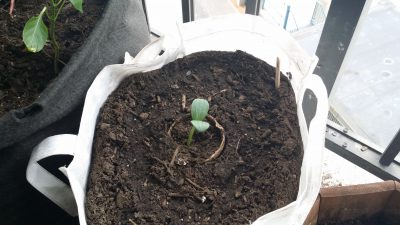
Last year I tried to grow summer squash but it turned out to be an unmitigated disaster. I don’t have pictures of how it “just simply” died on me. I’m sure I did something wrong but what that was, I don’t know. So this year I’m going for butternut squash. I know it’s a fall/early winter vegetable but I’m starting it now. Since space (and money) is an issue I’m growing it in a bag.
Amaranth. Amaranth. Amaranth. I chant it like a mantra because it is so important and valuable to me! This variety is green amaranth. I’ve already started snipping it to eat because once I found it was the source of the callaloo I ate as a child, well that was all she wrote!

Potatoes are the bane of my gardening life. They take so damn long to form the tubers I love that I annually lose patience with them. This year is no exception! The pot in the background is a transplanted potato plant that I hope grows. As you can see, the AC is on my balcony and that makes things harder because of all the hot air backwash. The foreground potatoes seem to be doing well. In the spirit of companion planting, I’ve also planted mustard greens with them. When they grow their true leaves, I’ll start to thin them out.

I’m growing other things as well; primarily greens because I really want to try my version of homesteading by freezing what we can’t eat so that during the coming winter, we’ll have fresh, homegrown greens to eat. At this point they’re too tiny to share.
I Represent
I represent the oppressed black womb
penetrated too early in its development.
No one takes the time to explain abortion
before I am strapped in the clinic gurney
to have the baby he planted scraped out.
One day, I was watching Dora and the next day
my teacher said I was a statistic. I don’t know.
I just know I’m not a little girl any more.
I represent the oppressed black vagina
smothered under an endless stream of men
who push and push but never take the time
to differentiate me from girl 6, 5, 4, 3, 2,
or even the one they call the bottom.
You only see me to call me names:
whore, trick, bitch.
One day I’ll be free of this stroll
and will only respond
to the name my mother gave me.
I represent the oppressed black woman
former stripper, former whore, former convict
who came through hell and back
yet still exudes sulfur.
Five children but crack obliterated
the memories and names of their fathers.
They look at me when I come home
smelling of a hundred billion sold
and say they’re hungry.
My response, before I close the bedroom door is
so am I, babies, so am I.
I represent the oppressed conscious black woman
who has all of her eyes open to see the world
but yet only inhabits 6 square blocks of the concrete jungle.
She sits at night with her seeds reworking homework lessons
of Christmas, Columbus and colonization.
She transforms the three R’s into righteous revolutionary rebellion.
Sometimes, I am allowed to sit in and participate in all of their lives.
Sometimes, the door is shut either angrily or in the silence of defeat.
Either way, I am still a poet and my pen represents the oppressed.

Here, I eat the chips
of childhood;
salt in the air
and salt and vinegar
in my mouth.
Salivating stillness
after the turtle-like triumph
of treading to the top
we put a period
on the promenade.
Proudly private people
we prostrate ourselves
in lounge chairs
designed for that express
purpose.
This is one of the views
that reduces reaction
to irrelevancy.
© 2016 Tichaona Munhamo Chinyelu (photo and text)
Lesson
Touring the Penn Center, St. Helena’s, SC
I am wading through the dark morass of history,
Beaufort at dusk fills with humid air from the swamps
and the mangrove of stagnant sea water’s calm
rice ponds, and the muttering old spirits,
the sharp lament of crickets and the trees close in
on us. The ground gives, stretches of white
sand, fresh earth that will not hold bodies.
Everything shifts here and the apocalypse of bodies
given up on holy nights is a common ritual.
I am teaching them about the bloody rituals
of human chattel, shattering all myths, all excuses—
the doctrine that it was ignorance, sheer prehistoric
stupidity that allowed such brute disregard
for the black soul. I am aware of how callous
these students grow to ward off the piss fear
of having no recourse but to weep or shed blood—
truth is the smashing of old comforts. I am telling
Carlos, Jerry, Uniqua to look into the past
of these South lands to find the squalid
histories of their blood; and why must I
offer them such heavy truths, these black
boys and girls who seem desperate for a language
of survival? Oh, that it was not anger, this lesson
of memory I now teach, but how can we touch
such gummy memory without ire? We must all learn
why we tear to hear a blue lament, a flat-toned
spiritual or see the stiff dangling image of a man,
a backdrop for a picnic? This room with its bland
track lighting—this modern orderly space—
grows dense with earth and trees, the stench
of death. In the photo gallery, the faces stare back
at us: country, African, crude images of ourselves—
the students point and laugh as if afraid to admit
the truth staring back shyly in black and white.
Before anger comes the shame or something mocking
like inexplicable laughter. I offer them love—
what I think is the narrative of survival,
then we listen to Mos Def as we drive through
the swamp, the blackening Atlantic at our backs.
#7: If the poem came from God don’t ask me to edit God.
#28: At their best our poems have taught us things we never knew we knew. We just have to let them.
#29: Here is a tricky one: the poem is not so much in the image itself but in the moment that demands the image. Consider it.
#30: Call it subconscious, call it art, but a poem wants to go where it wants to go. If you let it, aahh, bright wings!
#36: You can write about anything you want, but some subjects come with greater responsibility than you may want to take on.
#47: At the very least find out why they say the “greats” are great before you dismiss them for being dead and not like you.
Source: MEMO TO POETS – kwamedawes.com
(Originally posted on my book review blog, Diary of a Mad Reader)
I am someone who reads books that break my heart, time and time again. The Book of Night Women broke my heart. Apparently, A Brief History of Seven Killings, which I’m 14 pages away from finishing, is going to do the same. And they’re both by Marlon James.
I so want to say that I hate him and his damn novels but that wouldn’t be true. They resonate too deep for hate. The Book of Night Women stayed with me so long I was extremely reluctant to buy A Brief History. I waited; saw it in my favorite bookstore, saw it win prestige and still said I ain’t buying fucking bullshit that breaks my fucking heart. I nah fi do it.
But…
Marley
whose music reached me before Prince.
Marley
whose reggae connected me to my family in a way no other music does.
And so I bought it…and started reading.
Fucking Marlon James, man. I mean, damn.
I can’t fault him for his knowledge, or sense, of history. I can’t fault him for me reading past the sick ass murder that occurred in the first few pages. I can’t fault him anymore than I could fault Dylan for Masters of War or NWA for Fuck the Police or War for The World is a Ghetto because neither him or Dylan or NWA or War are the originators of this violent ass world I’m raising my son in.
I can’t even fault him for my reaction to a book that I haven’t yet finished, although I only have 14 pages left out of a 686 page novel. I can’t fault him for me feeling sorrow for the fictional psychopath Josey Wales. I can’t fault him because he’s an honest writer. His research is solid. His writing is beyond great. I can’t do anything but finish the novel, post this review and this song…
Selassie I Jah Rastafari
Addendum: I just finished the book. Considering the deranged violence that occurred throughout the book was that I would end it smiling and happy but I did! I’d read the whole tome all over again just to read that ending but first, I need a year or two to recover, just like I did with The Book of Night Women. With this ending, I do believe Marlon James has joined my very small list of favorite writers.
 Tichaona Chinyelu
You must be logged in to post a comment.