
Source: Jamaica to Honor Reggae Icon Peter Tosh with a Museum
Genealogy of a Colony: A Marker for Pocahontas
What it was like, for me,
from my perspective,
didn’t survive; wasn’t deemed
worthy of documentation.
My vagina was turned
into a conduit for colonialism.
Colonialism went in
and when it came out,
I was pretty much erased.
Any remnant of remembrance
was converted to Christianity
and I ended up dying
so far from my home
so far from the people
who, despite letting me languish
a whole year and then some,
still would not have slept
on my grave.
This is their perimeter of peace.
This is why it’s personal
and why I, Pocahontas,
permute my personality
for the poet.
Genealogy of a Colony: The Peace of Pocahontas: William Byrd Cento II
The poor Indians would have had less
reason to complain
that the English took away their land
if they had received it
by way of portion
with their daughters.
A sprightly lover is the most prevailing missionary.
If a Moor may be washed white
in three generations
surely an Indian
might have been blanched
in two.
Cento sourced from The Westover Manuscripts
Genealogy of a Colony: Sir Walter Raleigh: William Byrd Cento I
That bewitching vegetable, tobacco
first came to England
by sir Walter Raleigh
that great ornament of the British nation
who, to his royal mistress,
could do no less
than make a present
of the brightest.
Whether that gentleman
ever made a voyage
to that part of the northern American continent
now under the dominion of the king
is uncertain.
However, thus much may be depended on:
Sir Walter invited sundry persons of distinction
to share in his charter,
obtained from queen Elizabeth
of ever-glorious memory,
and join their purses with his
in the laudable project
of fitting out a colony.
A modish frenzy
made many fond of removing
to such a paradise:
expecting their coarsest utensils
would be of massy silver.
Cento sourced from The Westover Manuscripts
Genealogy of a Colony: Introduction
On my book blog, I have written about how absolutely fascinated I am by the Great Dismal Swamp. I have started but not yet finished Daniel A. Sayers’ A Desolate Place for a Defiant People: The Archaeology of Maroons, Indigenous Americans, and Enslaved Laborers in the Great Dismal Swamp; started but not yet finished Charles Royster’s The Fabulous History of the Dismal Swamp Company: A Story of George Washington’s Time; started and finished Sylviane A. Diouf’s Slavery’s Exiles. All that starting and not [yet] finishing led to a bout of writing that turned out to be a series of centos that basically described the founding of Virginia, one of the two states which formed around the Great Dismal Swamp.
Even though I have not yet finished two of the books mentioned above, research detours led me to The Westover Manuscripts written by William Byrd, colonial founder of Richmond, Virginia. The source material for the cento part of the series is drawn from that document.
I have been playing around with how to present these pieces since, at this point in time, they won’t be in my next book. I thought of just putting all the pieces in one post and letting them be read that way. But that idea didn’t sit too easy, visually speaking. So I decided to kind of serialize them.
Click here to read the first in the series.
I have never read any if her work [yet] but this quote makes me want to do so.
“Nobody reads poetry, we are told at every inopportune moment. I read poetry. I am somebody. I am the people, too. It can be allowed that an industrious quantity of contemporary American poetry is consciously written for a hermetic constituency; the bulk is written for the bourgeoisie, leaving a lean cut for labor. Only the hermetically aimed has a snowball’s chance in hell of reaching its intended ears. One proceeds from this realization. A staggering figure of vibrant, intelligent people can and do live without poetry, especially without the poetry of their time. This figure includes the unemployed, the rank and file, the union brass, banker, scientist, lawyer, doctor, architect, pilot, and priest. It also includes most academics, most of the faculty of the humanities, most allegedly literary editors and most allegedly literary critics. They do so–go forward in their lives, toward their great reward, in an engulfing absence of poetry–without being perceived or perceiving themselves as hobbled or deficient in any significant way. It is nearly true, though I am often reminded of a Transtromer broadside I saw in a crummy office building in San Francisco:
We got dressed and showed the house
You live well the visitor said
The slum must be inside you.
If I wanted to understand a culture, my own for instance, and if I thought such an understanding were the basis for a lifelong inquiry, I would turn to poetry first. For it is my confirmed bias that the poets remain the most ‘stunned by existence,’ the most determined to redeem the world in words..”
― C.D. Wright, Cooling Time: An American Poetry Vigil
Miles Lennon
He brings Miles.
I bring Lennon.
Both of us side-eyeing
the other;
both musicians atrocious
to women
but in his eyes, race trumps gender
each and everytime.
I don’t know what to do with that
except throw it away.
So I do
feeling kind of run down
voodoo blue
Nobody told me
about instant karma.
Faces and Masks Cento
I don’t normally incorporate poetic forms in my work but having come across the form of the cento, I thought that sounds interesting. I flipped through several books to pick the words that would form the basis of the piece. The lyricism of Eduardo Galeono’s trilogy Memory of Fire fired my imagination the most for this exercise and so I went with Faces and Masks, the 2nd volume in the series. Here is my attempt at a cento:
Ever since dawn
the ground has been steaming
pleading for a drink
while the living seek shade
and fan themselves.
Hidalgo spent the night with his eyes
fixed on the ceiling of the cell
saying goodbye:
my father didn’t put me among the rich
or the generals or those who have money
or claim to have it.
my father put me with the poor
because i am poor.
At the edge of the village of Morón
a common grave
swallows the bones of a poet
who until yesterday
had a guitar
and a name.
His unshrouded body
ends up in the earth;
his couplets, also naked,
also plebeian,
abide in the winds.
On the street
someone plucks
lamentations
from a guitar.
Something, Not Nothing
Earlier today I was hit with the desire to post a blog but I had no idea what to write about. I inquired of my resident expert “What do you think I should blog about?” but then we got busy getting him to the barbershop and then school. Errands were needed to be run. A book to be bought. And now it is post 5pm. My child, who had the whole of last week off from school [we are no longer homeschooling although he does attend a self-directed learning school] in observance of a national holiday we don’t celebrate used the time to wreck his schedule by turning into a Minecraft night owl, is asleep. Mother Nature and Daylight Savings has turned the 5 o’clock hour into nighttime and I am having a glass of wine as I type this.
But let me backtrack for a minute. It is imperative (yes, imperative!) that I state that the errands mentioned above included finally getting the glasses I desperately need in order to read my dearly loved books without having to resort to large print! But … it turns out I don’t know how to wear glasses. Let me be more precise. I don’t know how to see through bifocal glasses. I wanted glasses that enabled me to continue reading but turns out I needed “distance” glasses as well. So the science of the matter dictated that I got bifocal glasses that I don’t know how to see of. The optometrist told me to “raise my head and lower my eyes” in order to read. You should see me trying to do it. I look like someone who hears, and feels, the beat of music but can’t quite get the rhythm right enough to head nod without looking spastic. If every video (or picture) I took of myself didn’t come out absolutely awful, I would show you but they do so you’re just going to have to trust me.
I mentioned above that the errands I had to run included buying a book. This is the book:

Triggers are usually seen as a negative but in the case of A Year of Yes, the triggers “yes” set off are positive. I’m not going to go into all of them but I will say one of them: John Lennon’s first encounter with Yoko Ono. John’s Yoko-sponsored trip into the world of yes started with that meeting. I flirt with yes; have philosophical conversations with yes and now with this book, Shonda has become my metaphorical Yoko. What might I accomplish if I spend 2016 positively, consciously, saying yes? I’ve said no plenty. Maybe it’s time to flip the yang, so to speak.
So….this is how you write about “nothing”. When I was in high school, I used to have conversations with teachers outside of the classroom. One teacher told me when I have nothing to write about, write about nothing. This is me writing about nothing. But what is really nothing? How can you quantify nothing? You can’t.
But yes? Yes is something. Saying yes is something. And I am saying something, not nothing.

Collards
They’re not on my list of favorite greens. That honor is bestowed on sweet potato leaves, callaloo (amaranth), various kinds of kale and spinach. However stopping by a community garden I saw the collards below.
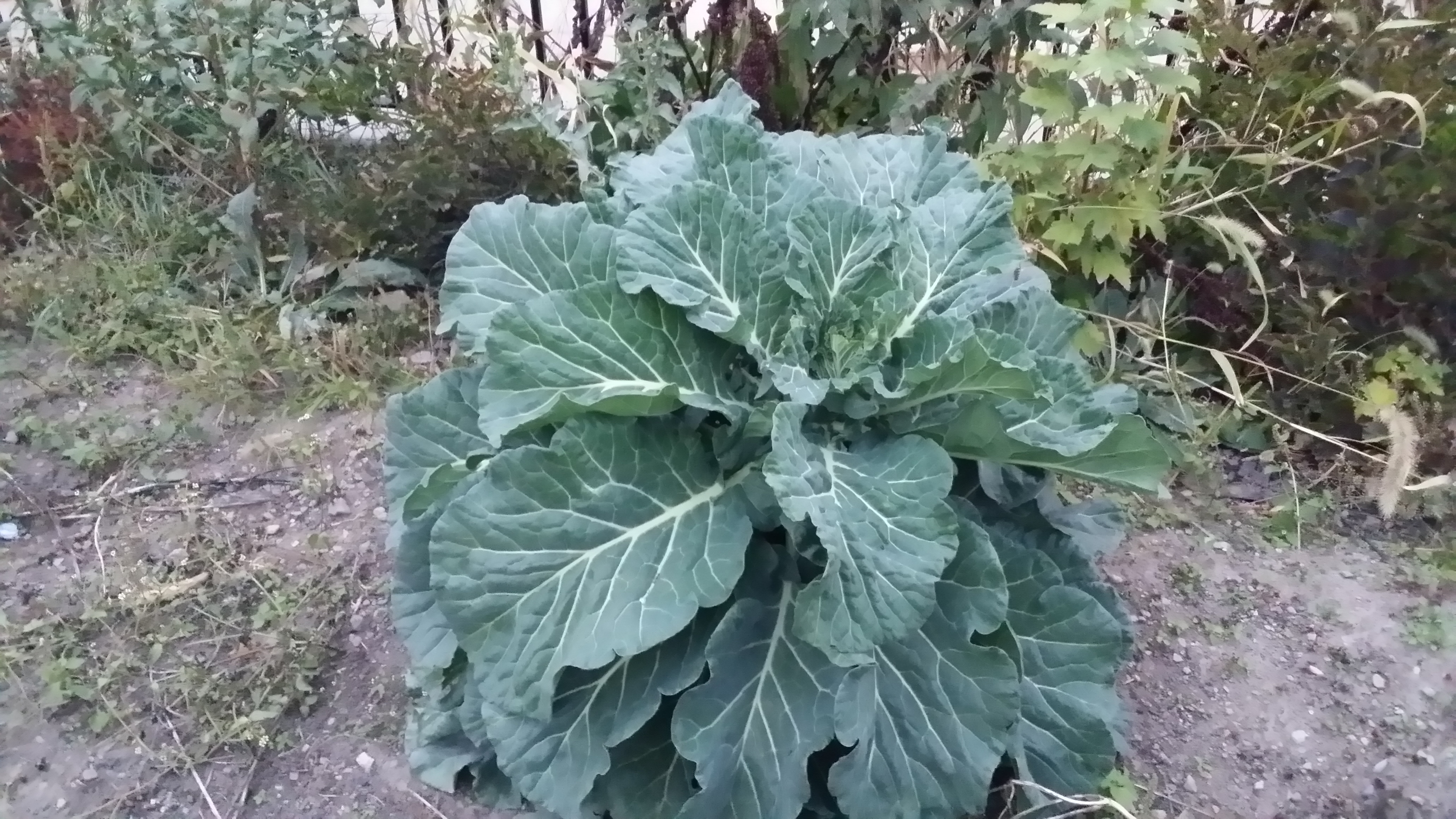
In a garden overly devoted to beans (monoculture), it was a welcome, glorious sight. I made it a point, when I was in the neighborhood, to park near the garden just so I could look at it. A few weeks ago, I stopped by and it looked like this:
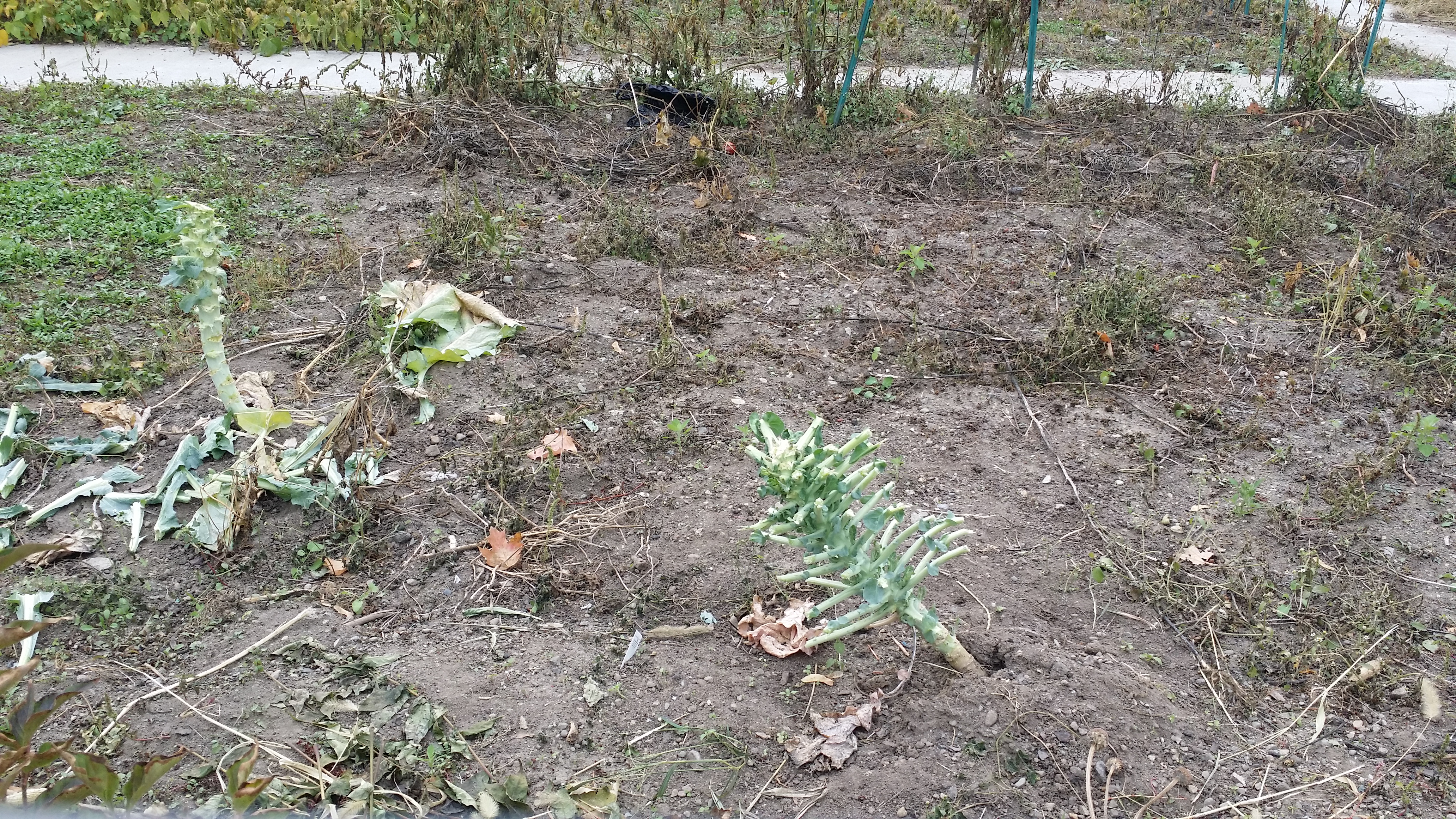
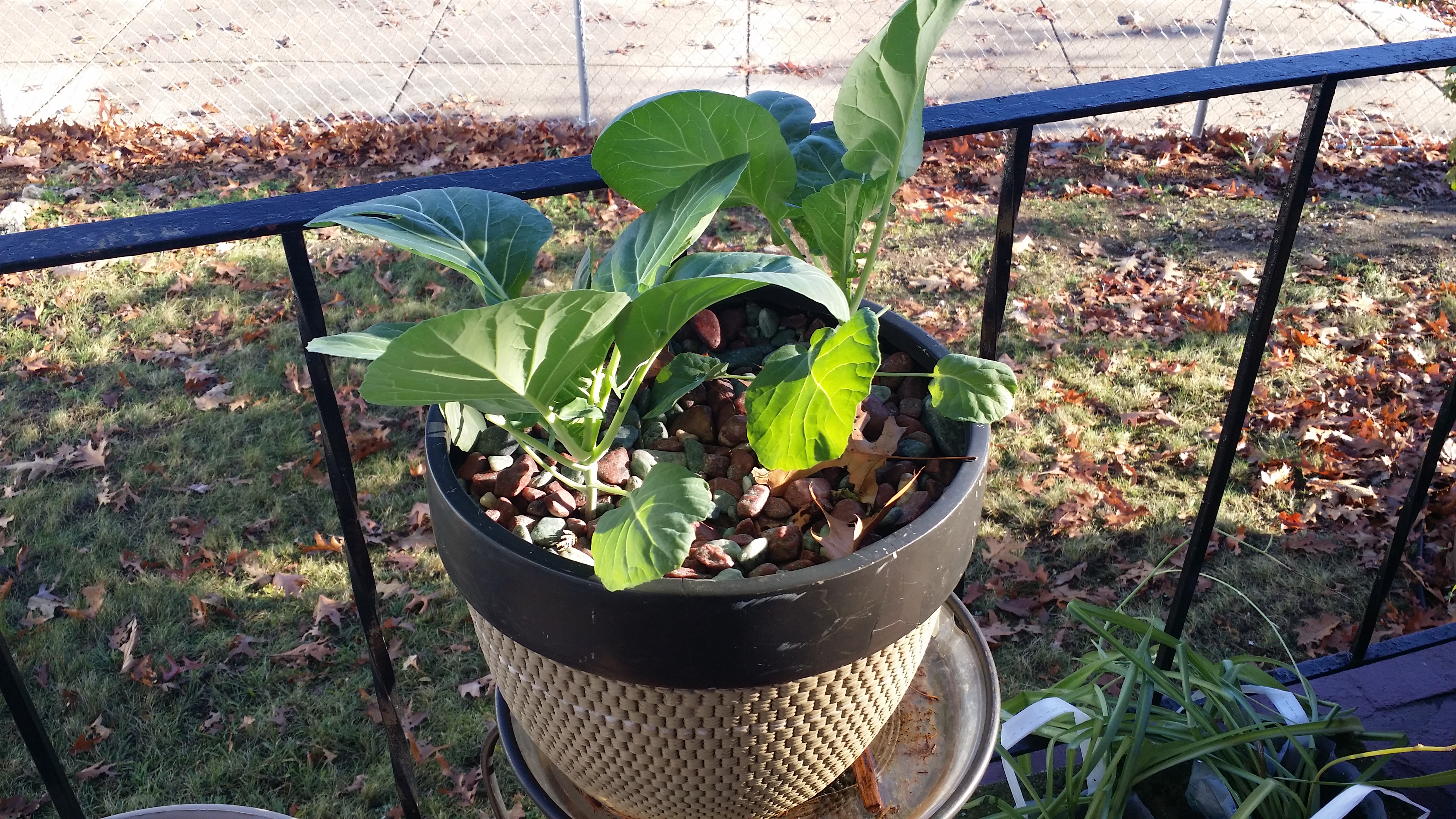
Some one, some family, will eat well, I thought. I was also inspired to try my hand at growing this green admittedly not one of my favorites. I bought a starter plant from a local farm, re-potted it and aside from lackadaisical watering, basically left alone. Yesterday, it rained, heavily. This is what the plant looked like earlier today:
I am also practicing what I call lackadaisical gardening with some kale planted in my mother’s yard. I have watered it even less than I have the collards. It appears to not need my care or attention:

When we lived in Brookline and community gardened, my plot neighbor had kale growing taller than me! I neglected to ask her how long she had been growing the kale but it had to be a minimum of 2-4 years. It could almost be said to be growing wild, if such a thing is possible in a community garden. Of course the growth is due to the self-seeding nature of the vegetable. Now, kale is not on my list of native plants that I want to populate my mother’s yard with but the nutritional value outweighs that consideration.
With both the kale and the collards I plan on continue to not paying them any attention. I want to see how they do, especially with winter around the corner!
 Tichaona Chinyelu
You must be logged in to post a comment.