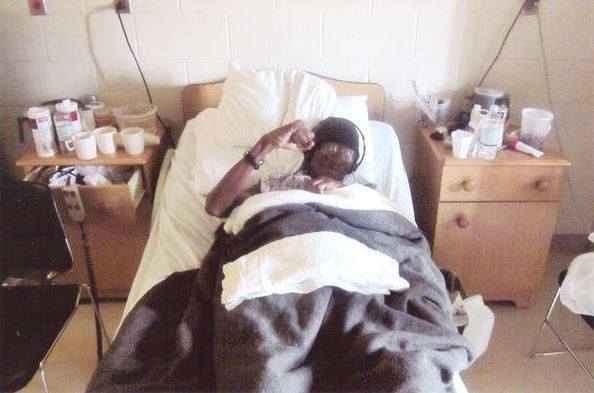
For Herman Wallace (and all of them)

68681_527441997342704_896360798_n

Beauty

Beauty is in the eye of the beholder
and I be holding beauty
when I glance upon them
theoretically shaping
the future into an afro-
concentric sharpness
that shook
the white power structure
into confronting
a black consciousness
organized with a mandate
and a mission
to dismiss
that old time religion
that said
everything in its place
especially the black race.

A new paradigm of blackness
rooted in a community soliloquy:
ghetto equals colony
and racism is the bastard child
of fascist economies.
Fanon, Malcolm and James
became antidotes
for antiquated theologies
and anti-social pathologies.

In the belly of the imperialistic beast,
in the microcosm of prisons
and the macrocosm of streets
a new paradigm for blackness,
a paradise of struggle,
was created by young soldiers
high school students,
whores and pimps,
drug dealers and NASA employees,
doctors and number runners
heady
ready
and willing
with
fuck that shit
far too many fires lit
from Watts to the Congo

Whitey gotta go
burn baby burn
no ashes in the urn
time for the tide to turn
and put an end to the yearn

discern

panther power was here
turned the police into pigs
and nigs into blacks
figuratively burning effigies
with tactics and strategies
that earned them freedom’s mind.


Herman Wallace Dies Just Days After Being Released from 40+ Years in Solitary

How Elsie Became Tuyet

Elsie was a straight A student,
a dutiful daughter and a speaker
of three languages.
I was nothing of the sort
but still, we became friendly enough
that I was able to ask
why the French teacher called her
Tuyet.

Americans say its hard to pronounce.

I tested it on my one language tongue.
Tuyet.
Two syllables.
Elsie.
Two syllables.

I could see no difficulty
and so discarded Elsie.

When she told me that her family
decided that she is to marry
I remembered the teenage Haitian girl
who used to live across the hall.
Enamored with her boyfriend’s anatomy
she had names for various parts
and one of those named parts
led to a hurried wedding ceremony
at the local Seventh Day Adventist Hall
as well as her disappearance
from my life..

Back then, being called Haitian was worse
than being called nigger.
but I didn’t care.
She was cool and pretty
and made me not want to have sex.

Tuyet was cool and pretty
and also on the edge
of a disappearing act.

She left me
with a picture of herself
in a spring blue and white dress
and a pageboy haircut
that stands out
more than her face.

Frederick Douglass by Robert Hayden

When it is finally ours, this freedom, this liberty, this beautiful
and terrible thing, needful to man as air,
usable as earth; when it belongs at last to all,
when it is truly instinct, brain matter, diastole, systole,
reflex action; when it is finally won; when it is more
than the gaudy mumbo jumbo of politicians:
this man, this Douglass, this former slave, this Negro
beaten to his knees, exiled, visioning a world
where none is lonely, none hunted, alien,
this man, superb in love and logic, this man
shall be remembered. Oh, not with statues’ rhetoric,
not with legends and poems and wreaths of bronze alone,
but with the lives grown out of his life, the lives
fleshing his dream of the beautiful, needful thing.

Excerpted from Collected Poems of Robert Hayden

(6/30)

a generation of violets
spreads into english gardens
formerly manicured
with the precision
of the queen’s english.

exigent circumstances
leads to a silence
which tries but fails
to silence desperate
desires for cassava
and groundnut

in love (secretly) with sister killjoy’s
black-eyed squint
they spread not
their language to their seeds
who travel far
on diasporic planes

and who, when they return,
need the rosetta stone

to decipher their source

things of water (slowly solidifying)

the women wet
the waterfront
with womb water
delivering twin coral children
whose ceilings
are fluid
and permutable.

he is one. i am the other.
brother and sister
who knew our selves
before brackishness
and the rift
caused by the damming
of the river.

she and i, twin occupiers
of our mother’s womb.
the hierarchy of birth order
mercurial
like gemini genes.

one stayed. the other went
-an absence that split the family
like a headache.

like choppy water
frothy and forthright
she spouts

destroying
the placidity of man
made emotion.

structurally unsound
deficient of reason
wet like a woman
she is fit
only for swallowing.

having grown to the depth
of a well
i could contain her
but don’t

having imbibed
and libated enough
to be at peace
i watch

she, whirling watery dervish
leaving in her wake
smashed houses
cars and broken glass
planes of an existence
thought permanent.

Parsley ~ Rita Dove

1. The Cane Fields
There is a parrot imitating spring
in the palace, its feathers parsley green.
Out of the swamp, the cane appears

to haunt us, and we cut it down. El General
searches for a word; he is all the world
there is. Like a parrot imitating spring,

we lie down screaming as rain punches through
and we come up green. We cannot speak an R-
out of the swamp, the cane appears

and then the mountains we call in whispers Katalina.
The children gnaw their teeth to arrowheads.
There is a parrot imitating spring.

El General has found his word: perejil.
Who says it, lives. He laughs, teeth shining
out of the swamp. The cane appears

in our dreams, lashed by wind and streaming.
And we lie down. For every drop of blood
there is a parrot imitating spring.
Out of the swamp the cane appears.

2. The Palace
The word the general’s chosen is parsley.
It is fall, when thoughts turn
to love and death: the general thinks
of his mother, how she died in the fall
and he planted her walking cane at the grave
and it flowered, each spring stolidly forming
four-star blossoms. The general

pulls on his boots, he stomps to
her room in the palace, the one without
curtains, the one with a parrot
in a brass ring. As he paces, he wonders
who can I kill today. And for a moment
the little knots of screams
is still. The parrot, who has traveled

all the way from Australia in an ivory
cage, is, coy as a widow, practicing
spring. Ever since the morning
his mother collapsed in the kitchen
while baking skull-shaped candies
for the Day of the Dead, the general
has hated sweets, He orders pastries
brought up for the bird; they arrive

dusted with sugar on a bed of lace.
The knot in his throat starts to twitch;
he sees his boots the first day in battle
splashed with mud and urine
as a solder falls at his feet amazed-
how stupid he looked!-at the sound
of artillery. I never thought it would sing
the soldier said, and died. Now

the general sees the fields of sugar
cane, lashed by rain and steaming.
He sees his mother’s smile, the teeth
gnawed to arrowheads. He hears
the Haitians sing without R’s
as they swing the great machetes:
Katalina, they sing, Katalina,

mi madle, mi amol en muelte God knows
his mother was no stupid woman; she
could roll an R like a queen. Even
a parrot can roll an R! In the bare room
the bright feathers arch in a parody
of greenery, as the last pale crumbs
disappear under the blackened tongue. Someone

calls out his name in a voice
so like his mother’s, a startled tear
splashes the tip of his right boot.
My mother, my love in death.
The general remembers the tiny green springs
men of his village wore in their capes
to honor the birth of a son. He will
order many, this time, to be killed

for a single, beautiful word.